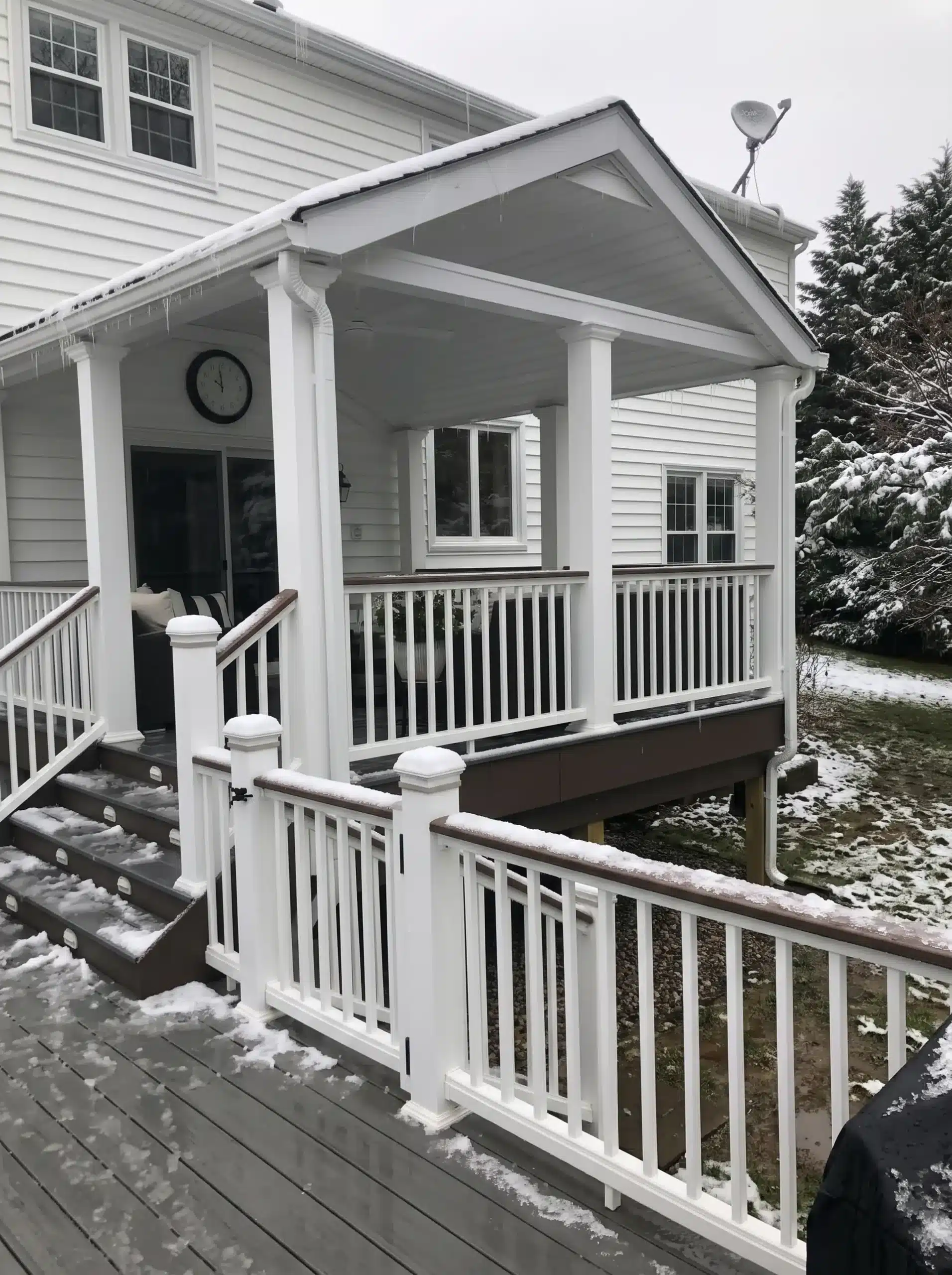
Quick Answer: Can you build a deck in winter? In many cases, yes, when the site, soil, forecast, and product instructions allow each task to be done safely and correctly. Winter deck construction is not automatically cheaper or faster. Frozen ground can delay footings, cold days complicate concrete, and composite boards need wider end gaps when installed in the cold. A site-specific assessment matters more than the month on the calendar.
It is a gray January morning in Kennett Square. The maples are bare, frost glitters across the lawn, and the yard that felt crowded with summer plans now looks wide open. For many families in Southern Chester County and New Castle County, this quiet season is the first good chance to plan a deck, which raises the question. Can you build a deck in winter and still get a structure that holds up for decades?
At SB Builders Group, the family-run deck builder based in West Grove, PA, owner Shane Braxton and lead carpenter Jared Braxton evaluate each property before anyone circles a start date. Here is what they weigh, and what to ask any builder before committing to a winter start.
Can Weather and Ground Conditions Support Winter Deck Construction?
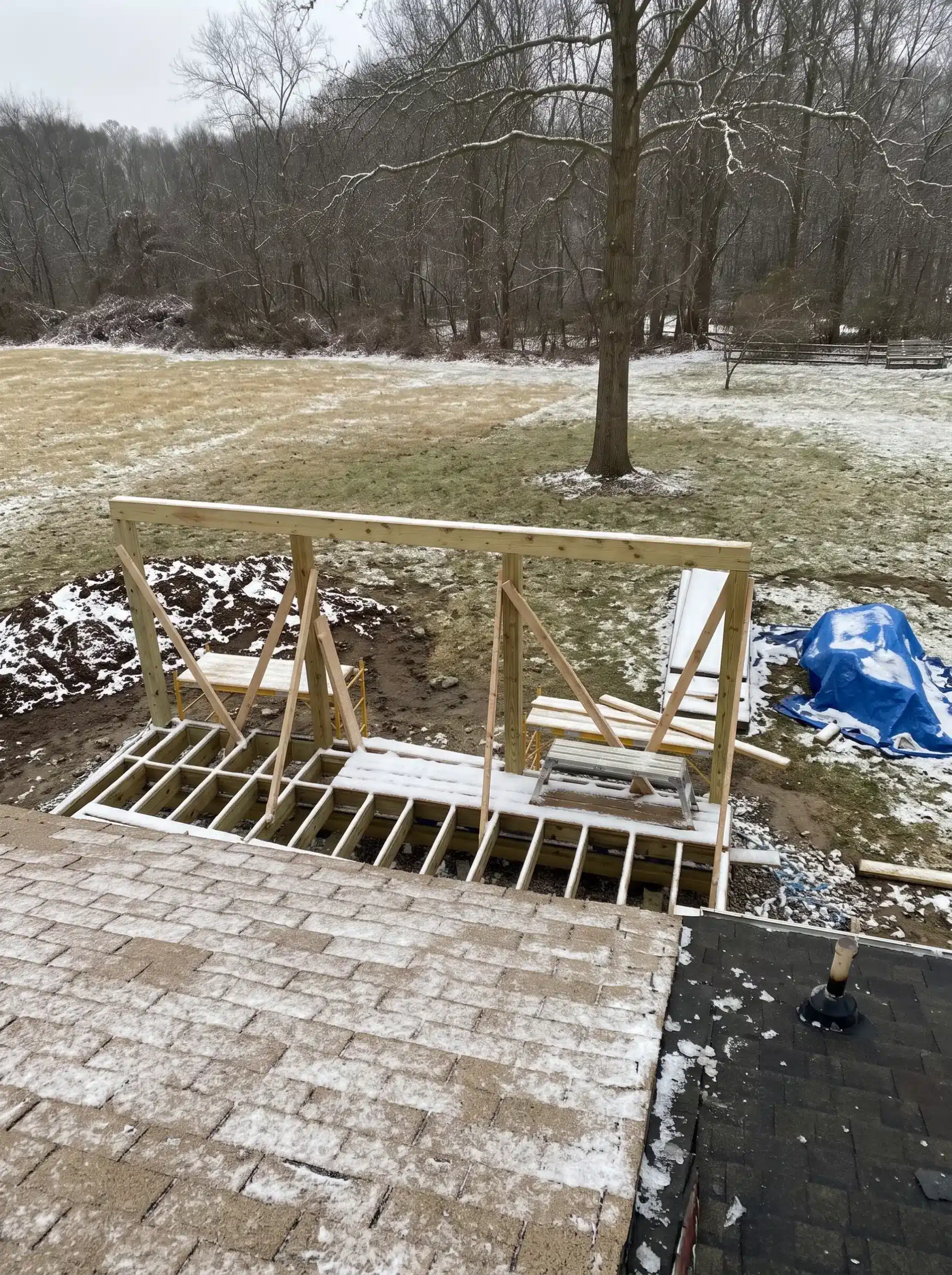
Deck building in cold weather works only when conditions protect both the structure and the crew, and snow alone rarely decides it.
- Get Below the Frost Line: Footings are the part of a deck most affected by winter. In southeastern Pennsylvania, code commonly requires footings at least 36 inches deep, and New Castle County’s deck footing checklist calls for a footing base at least 32 inches below grade that is free of mud, water, and frozen soil. Your township or county sets the exact number, so confirm it during permitting.
- Respect the Concrete Clock: Under the American Concrete Institute’s cold-weather guidance, conditions count as cold when air temperatures fall to or below 40°F during the protection period. Fresh concrete needs to reach roughly 500 psi before it can withstand freezing, and freezing in the first hours can cut potential strength by as much as half. Winter footing pours call for a mild forecast, insulated blankets, or a short wait.
- Read the Snow, Not Just the Forecast: Can you build a deck in snow? Sometimes, but snow depth, active snowfall, and the specific task all matter. A few inches can hide uneven grade, drainage problems, and buried obstacles, while icy joists make layout and lifting unsafe.
- Expect Freeze and Thaw Swings: Mid-Atlantic winters can swing from thaw to freeze in the same week. You can still frame a deck in freezing temperatures, but a sudden thaw can turn the work area into mud.
Pro Tip: Ask whether you can dig and pour footings during a late-fall window, before the ground freezes. With footings set, framing and decking can often continue through milder winter days.
Which Materials and Installation Steps Need Winter-Specific Planning?
Winter deck installation follows the same structural rules as a July build, but as temperatures drop, each product’s rules for cutting, fastening, and finishing tighten.
- Follow the Gapping Table: As a TimberTech Platinum Installer, SB Builders Group works from TimberTech’s published butt-joint gapping table. Composite boards are shorter in the cold, so the colder the install day, the wider the gap where board ends meet. Skip that adjustment in January, and boards can press against each other by July.
- Pre-Drill When It Is Cold: TimberTech requires pre-drilling face-fastened Composite boards in cold weather to prevent end splitting and screw shear. TimberTech Advanced PVC boards need no butt-joint gap at any temperature, making them a practical winter choice for some composite deck designs.
- Protect the Frame: SB Builders Group’s deck framing places pressure-treated joists 16 inches on center and aluminum joists 24 inches on center, adds joist tape to the tops of wood joists, and seals the ledger with flashing and waterproof flashing tape. Tapes and adhesives list their own minimum application temperatures, so surfaces must be dry and the day must be suitable.
Infographic: The Composite Decking Temperature Ladder
Table 1: Which Deck Tasks Can Move Forward in Winter?
| Task | Winter Outlook | What Controls It |
|---|---|---|
| Design, measuring, and permitting | Strong fit | Office and township schedules, not weather |
| Utility marking through 811 | Strong fit | Advance notice to the one-call center |
| Excavating footings | Depends on frost | Frozen or saturated soil |
| Pouring concrete footings | Needs a weather window | Cold-weather protection while it cures |
| Wood or aluminum framing | Often workable | Ice-free lumber and safe footing for the crew |
| Composite or PVC decking | Often workable | Install-day temperature |
| Railings and lighting | Often workable | Dry conditions for wiring and fastening |
| Stain or sealant on wood | Usually waits | Product minimum application temperature |
Pro Tip: One of the most useful cold-weather deck building tips is simple. Ask which product lines appear in your quote and what each manufacturer requires at the temperatures expected during your build.
Is Winter a Good Fit for Your Deck Schedule and Budget?
Can you build a deck in winter on a timeline that works for your family? The best time to build a deck depends on scope, local weather, product limits, site access, and how much flexibility your household has for pauses.
Interest in outdoor living keeps growing. Decks remain the most common outdoor structure upgrade in the 2026 Houzz Outdoor Trends Study, chosen by 43% of renovating homeowners, and a record 71% of those homeowners hired a professional. A September 2026 Trex survey found that 48% of homeowners say the ability to upgrade their outdoor space influences whether they stay in their current home at all.
- Look Beyond a Seasonal Discount: Winter deck-building costs don’t follow a predictable pattern. Concrete blankets, snow removal, and temporary protection can add cost, while weather pauses can stretch labor. Compare project scopes rather than relying on a seasonal price assumption.
- Match the Build to How You Will Use It: If the goal is enjoying the outdoors in January, a covered deck, a fire feature from SB Builders Group’s outdoor living features, or a four-season room with insulation, heating, and cooling from its sunrooms and enclosures lineup may serve you better than an open deck.
- Ask for a Clear Plan: Before choosing a start date, ask the builder to identify weather-sensitive tasks, likely reasons to pause, how pauses will be communicated, and how changes could affect the sequence and estimate.
Table 2: Winter Start vs. Spring Start
| Factor | Winter Start | Spring Start |
|---|---|---|
| Design and permits | Quieter season for planning and approvals | Calendars fill as outdoor season nears |
| Weather pauses | More likely during freeze and thaw cycles | Fewer cold pauses, more rain days |
| Cost drivers | Cold-weather protection and snow removal | Fewer weather-related extras |
| Ready for use | Often ready as the weather warms | May finish later in the season |
| Best fit for | Households with flexible deadlines | Households with a firm date to meet |
Pro Tip: If a firm date matters, such as a graduation party or a summer move, build the schedule backward from that date and leave room for winter pauses.
How SB Builders Group Plans a Winter Deck Project
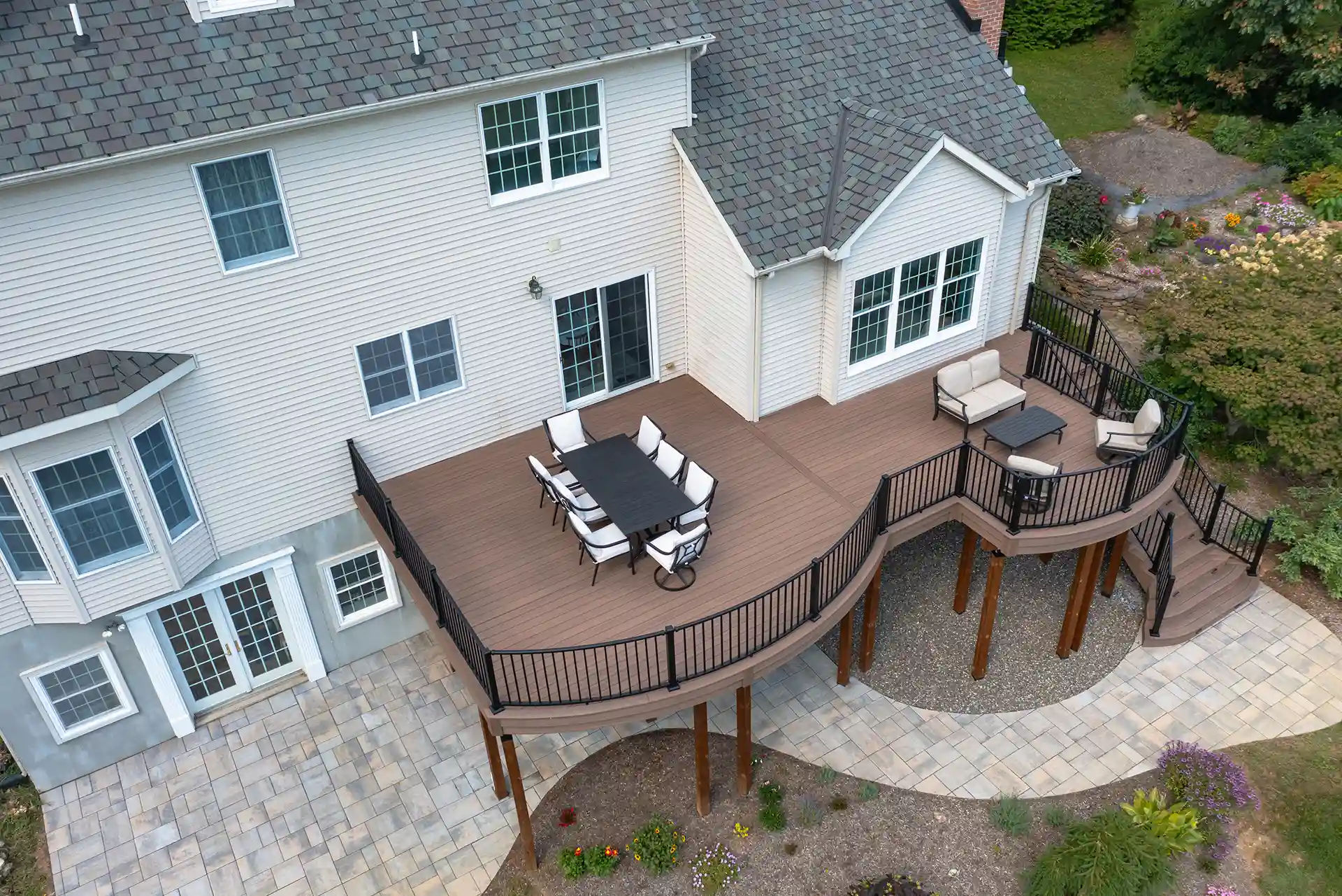
SB Builders Group officially launched in January 2020, a winter start. Led by a third-generation carpenter, the crew treats each project like their own home, and winter projects follow the same four steps as every custom deck.
- Consultation and Design: The team measures the site, studies grade and drainage, and builds a plan around your goals.
- Stress-Free Permitting: SB Builders Group handles permits and code requirements.
- Quality Construction: Weather-sensitive steps are sequenced around safe windows.
- Final Review: The crew walks the finished deck with you to confirm every detail.
The team serves West Grove, Avondale, Kennett Square, Landenberg, Lincoln University, Chadds Ford, and West Chester in Pennsylvania, along with Newark, Hockessin, and Greenville in Delaware.
Can You Build a Deck in Winter FAQs
Do I still need a permit if I build my deck in winter?
You do. The season does not change permit or inspection requirements, and rules vary by township and county. SB Builders Group handles the paperwork, so your part is the permit fee. You may need to schedule footing inspections around frozen-ground days.
Should underground utilities be marked before footing work starts?
Always. In Pennsylvania, call 811 at least three business days before digging. In Delaware, Miss Utility needs at least two full working days and no more than 10. Snow can also bury or wash out paint marks, so ask for a re-mark if they disappear before digging.
Can property lines affect where a new deck can go?
Yes. Local zoning sets minimum setbacks from property lines, and those distances differ by township. If survey pins are buried under snow, rely on your plot plan or survey, not guesswork, and confirm the location during permitting.
Can a new deck connect to my existing staircase?
Sometimes. The stairs have to match the new deck’s height, layout, and condition. Residential code generally caps stair risers at 7 3/4 inches, with no more than 3/8 inch of variation between them, so a height mismatch often means rebuilding the stairs rather than reusing them.
How long does a winter deck build take?
It depends on size and complexity. SB Builders Group completes framing on most projects in two to five days, while larger or multi-level decks take longer. Footing and concrete days come first, and the forecast sets their pace.
Can you stain a wood deck built in winter?
Usually not right away. Most stains and sealers list a minimum application temperature, and fresh pressure-treated lumber often needs time to dry before it accepts a finish. Plan the stain for a dry spring stretch. Composite decking skips this step because it never needs staining.
Can You Build a Deck in Winter? Talk With SB Builders Group
Whether your project suits a winter window or a spring start depends on your property. Call SB Builders Group at (484) 643-2868, Monday through Friday, 7 AM to 6 PM, or schedule a consultation to map out a start date that fits your home.